
Original YouTube link Rumble link Bitchute link
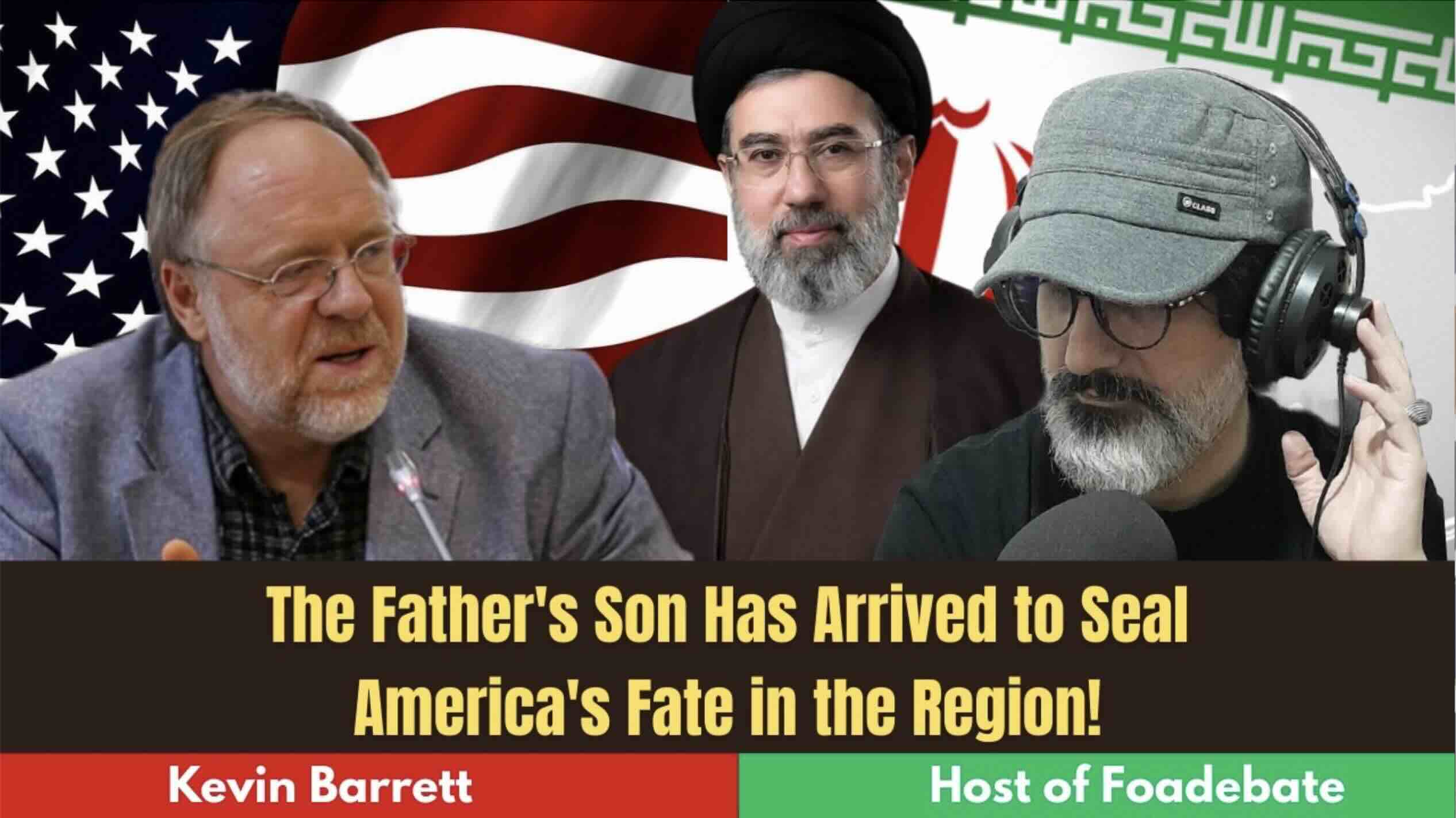
Foad of FoadDebate writes: In my latest conversation with Dr. Kevin Barrett, we unpacked the hidden dimensions and far-reaching implications of Iran’s new leadership selection, a development that has not only shaken domestic dynamics but has also sent shockwaves through the calculations of global powers. With his characteristic sharp insight, Barrett describes Western media attempts to delegitimize this choice as textbook war propaganda, completely at odds with the realities on the ground and the public embrace of Iran’s revolutionary path. Dismissing Trump’s interventionist rhetoric about the new leader being “unacceptable,” he frames such statements as a theatrical display of a declining U.S. hegemony. Barrett emphasizes that the selection of Ayatollah Seyed Mojtaba Khamenei, given the impeccable ethical track record and integrity of his family, is not only a strategic necessity amid the current full-scale war but also a powerful promise to continue the steadfast revolutionary line that has stood firm against Western overreach.
Structured Summary of the Interview
Introduction and Topic: Leadership Transition in Iran (00:00:00–00:00:33)
The interview opens with the host welcoming viewers and introducing the topic: the selection of Sayyid Mojtaba Khamenei as Iran’s new Supreme Leader following the death of Ayatollah Ali Khamenei. The host asks Dr. Kevin Barrett to comment on criticisms from opponents of the Islamic Republic who argue that Mojtaba Khamenei’s appointment lacks legitimacy, particularly because he is the son of the previous leader.
Barrett thanks the host and frames the discussion within the broader geopolitical context of the ongoing war involving Iran and its adversaries.
Western Criticism and Allegations of Propaganda (00:00:33–00:03:02)
Barrett argues that criticism of Mojtaba Khamenei’s leadership in Western media is part of a broader propaganda campaign connected to the war. According to him, Western governments and media outlets are attempting to portray events in a way that makes the United States and Israel appear successful while simultaneously undermining Iran’s leadership.
He claims these narratives are intended to weaken Iran politically by questioning the legitimacy of its political system. Barrett argues that such efforts are unlikely to succeed because most Americans know little about Iran and therefore are not deeply influenced by these narratives.
He also argues that within Iran, wartime conditions tend to increase unity around the national leadership rather than weaken it.
Regime Change Narratives and Alternative Leadership (00:03:02–00:04:30)
Barrett discusses what he sees as unrealistic Western attempts to promote regime change in Iran. He claims that the main alternatives often proposed by Western policymakers—the return of the Pahlavi monarchy or the leadership of the Mujahideen-e Khalq (MEK)—lack credibility and popularity within Iran.
According to Barrett, these groups are widely disliked by Iranians, making them ineffective as potential replacements for the Islamic Republic. He therefore interprets regime-change rhetoric as largely symbolic rather than a serious strategy.
He argues that the real goal of the war has been to damage Iran strategically rather than to genuinely replace its government.
Domestic Legitimacy and Reputation of the Khamenei Family (00:04:30–00:05:03)
Barrett emphasizes that the Khamenei family has a reputation in Iran for personal integrity. He states that Ayatollah Ali Khamenei was widely known for avoiding corruption and encouraging members of his family to maintain similar standards.
Because corruption is a common issue in many countries, Barrett argues that the perception of honesty within the Khamenei family has helped maintain their credibility. He also notes that Mojtaba Khamenei is reportedly respected by the Islamic Revolutionary Guard Corps (IRGC), which plays a crucial role in defending Iran during wartime.
For these reasons, Barrett believes the new leader is likely to have strong domestic legitimacy.
Donald Trump’s Statements and U.S. Pressure (00:04:33–00:08:39)
The host asks Barrett about statements by Donald Trump, who reportedly declared that Mojtaba Khamenei would be unacceptable as Iran’s next leader and suggested using a “Venezuela model” to change Iran’s leadership.
Barrett strongly criticizes Trump and characterizes his remarks as attempts to intimidate foreign governments. He argues that powerful states sometimes try to pressure other countries into accepting leaders favorable to their interests.
However, Barrett claims such tactics will not work with Iran because the country is politically and militarily resilient. He also argues that global respect for American leadership has declined and that Trump’s rhetoric illustrates that decline.
Barrett further claims that the United States is losing influence in the region, citing difficulties maintaining control over strategic areas such as the Persian Gulf and protecting military installations.
Impact of the New Leader on the War (00:08:41–00:10:27)
The discussion then turns to whether Mojtaba Khamenei’s leadership will change the course of the war. Barrett explains that the new leader is believed to be aligned with Iran’s “principlist” political faction, which favors strong resistance to Western pressure.
He contrasts this group with the reformist or pragmatic faction that previously hoped to improve relations with the United States and integrate Iran more closely into the global economy.
Barrett argues that recent events have strengthened the principlists’ position because attempts at diplomacy with the United States have repeatedly failed.
Distrust of the United States and Strategic Realignment (00:09:10–00:10:27)
Barrett cites the collapse of the JCPOA nuclear agreement as evidence that Iran cannot rely on agreements with Washington. He argues that the United States negotiated the deal but later withdrew from it, which he believes damaged trust.
He also claims that Iranian leaders have been targeted in attacks connected to diplomatic interactions, reinforcing the belief among many Iranian officials that negotiations with the United States are unreliable.
As a result, Barrett believes Iran will increasingly align with countries in the Global South, particularly China, rather than seeking rapprochement with Western powers.
Personal Stakes and Military Deterrence (00:10:27–00:11:01)
Barrett suggests that Mojtaba Khamenei has a personal motivation to pursue a strong defense policy because members of his family were reportedly killed during attacks connected to the conflict.
According to Barrett, this experience may reinforce the new leader’s commitment to strengthening Iran’s military capabilities so that similar attacks cannot occur again.
He predicts that Iran will continue expanding its deterrent forces and military infrastructure.
Historical Comparisons and Leadership Style (00:11:01–00:13:34)
Barrett compares Iran’s current situation to two earlier periods in the country’s history.
First, he references the era of Ayatollah Ruhollah Khomeini, when Iran faced the Iran-Iraq War during the 1980s. At that time, Iran was fighting for survival, and leadership required firmness and resilience.
Second, he discusses the period under Ayatollah Ali Khamenei, when there was still hope that diplomatic engagement with the West might improve relations. Reformists believed that normalization with Western powers might eventually be possible.
Barrett argues that the present conflict has ended those expectations. In his view, Iran has returned to a situation similar to the 1980s, facing what its leaders consider an existential threat.
He believes Mojtaba Khamenei’s leadership will reflect this more confrontational geopolitical environment.
Symbolism, Legitimacy, and “Barakah” (00:13:34–00:14:26)
Barrett suggests that Mojtaba Khamenei’s rise to leadership during a time of crisis may strengthen his legitimacy among supporters.
He refers to the Islamic concept of barakah, meaning divine blessing or spiritual authority. In some cultures, including Morocco, leaders who emerge during difficult times are sometimes believed to possess a special form of guidance or protection.
According to Barrett, this perception may give Mojtaba Khamenei a powerful symbolic role as the son of a leader who died during a national crisis.
Closing Remarks: Moral Framing of the Conflict (00:14:26–00:17:19)
In his concluding remarks, Barrett frames the conflict in moral terms, describing it as a struggle between good and evil in world politics.
He criticizes the actions of the United States and Israel and argues that their policies demonstrate extreme aggression and dishonesty. By contrast, he portrays Iran’s leadership as fundamentally sincere and morally motivated, even though it is not perfect.
Barrett also describes Iran’s defense strategy as a “mosaic defense,” meaning a decentralized system in which many independent actors contribute to the country’s protection. He suggests that people around the world who oppose Western policies should consider themselves part of this broader resistance.
The interview concludes with the host thanking Barrett for his analysis and insights.
BREAKING: New Supreme Leader’s First Message
The first message of the Iranian Leader was issued some minutes ago:
In the Name of God
At the beginning of my remarks, I must offer my condolences to our Master, may God hasten his reappearance, on the heartbreaking martyrdom of the great and eminent leader of the Revolution, the wise and beloved Khamenei. I also ask that His Eminence pray for each and every member of the great Iranian nation, indeed for all Muslims of the world, for all those who serve Islam and the Revolution, for the self-sacrificing ones, and for the families of the martyrs of the Islamic movement—especially those of the recent war—and also for this humble servant.
The second part of my words is addressed to the great nation of Iran. First, I must briefly explain my own position regarding the vote of the esteemed Assembly of Experts. This servant of yours, Seyyed Mojtaba Hosseini Khamenei, learned of the result of the vote of the esteemed Assembly of Experts at the same time as you did, through the broadcasting of the Islamic Republic of Iran. For me, to sit in the place that was once occupied by two great leaders—Imam Khomeini the Great and the martyred Khamenei—is an extremely difficult matter. This seat carries the legacy of one who, after more than sixty years of striving in the path of God and renouncing all kinds of pleasures and comforts, became a shining jewel and an exceptional figure not only in the present era but throughout the history of the rulers of this country. Both his life and the manner of his death were intertwined with a grandeur and dignity born from reliance upon the Truth.
I had the opportunity to visit his body after his martyrdom. What I saw was a mountain of firmness, and I was told that the fist of his healthy hand had been clenched. Those who are knowledgeable about the many aspects of his personality must speak at length about him. In this brief moment I suffice with this summary and leave the details for more appropriate occasions. This is the reason why sitting in the seat of leadership after such a person is difficult; bridging this gap will only be possible through seeking assistance from God Almighty and through the support of you, the people.
It is necessary to emphasize another point which is directly related to the essence of my words. Among the great qualities of the martyred leader and his great predecessor was bringing the people into all arenas, continuously enlightening them with insight and awareness, and in practice relying upon their power. In this way they actualized the true meaning of the public and republican character of the system, and they sincerely believed in it. The clear effect of this was seen in the past few days when the country was without a leader and without a Commander-in-Chief. The insight and intelligence of the great Iranian nation in the recent events, together with its perseverance, courage, and presence, caused friends to admire and enemies to be astonished. It was you, the people, who led the country and guaranteed its authority. The verse that I cited at the beginning of this text means that no sign of God ever disappears or is forgotten without God replacing it with something similar or even better.
The reason for citing this noble verse is not that this humble servant should be considered comparable to the martyred leader, let alone superior to him. Rather, the purpose of mentioning this verse is to draw attention to the proper and prominent role of you, the beloved nation. If that supreme blessing was taken from us, in its place once again the Ammar-like presence of the Iranian people was granted to this system. Know that if your power does not manifest itself in the arena, neither leadership nor any of the various institutions—whose true function is service to the people—will possess the necessary effectiveness.
For this meaning to be realized more fully, first of all remembrance of God Almighty, reliance upon Him, and seeking intercession from the pure lights of the Infallibles (peace be upon them all) must be regarded like the supreme elixir and the rare philosopher’s stone that guarantees various openings and a definite victory over the enemy. This is a great advantage that you possess and your enemies do not.
Second, unity among all individuals and groups of the nation—unity that usually manifests itself especially in times of hardship—must not be damaged. This can be achieved by overlooking points of disagreement.
Third, effective presence in the arena must be maintained—whether in the form that you displayed during these days and nights of war, or through various effective roles in social, political, educational, cultural, and even security spheres. What matters is that the correct role be properly understood and implemented as much as possible without harming social unity. One of the duties of leadership and certain officials is to remind different segments of society of these roles. For this reason, I emphasize the importance of participation in the upcoming Quds Day ceremony of 1447, in which the element of confronting the enemy must be taken seriously by everyone.
Fourth, do not neglect helping one another. Thanks be to God, this has always been a characteristic of most Iranians, and it is expected that in these special days—when naturally the situation may be harder for some members of the nation than others—this spirit will manifest itself even more strongly. I also call upon the service institutions to provide every possible assistance to those members of the nation and to the grassroots relief structures.
If these matters are observed, the path toward days of greatness and glory for you, the beloved nation, will be paved. The nearest example of this, God willing, could be victory over the enemy in the present war.
The third part of my remarks is to express my sincere gratitude to our brave fighters who, at a time when our people and beloved homeland have been unjustly attacked by the leaders of the front of global arrogance, have blocked the enemy’s path with their powerful strikes and have removed from them the illusion of being able to dominate or possibly divide our dear homeland.
Dear fighting brothers, the demand of the masses of the people is the continuation of effective and regret-inducing defense. Likewise, the lever of blocking the Strait of Hormuz must certainly continue to be used. Studies have also been conducted regarding the opening of other fronts in which the enemy has little experience and where it will be highly vulnerable; their activation will take place, if the war situation continues and according to considerations of expediency.
I also extend my sincere thanks to the fighters of the Resistance Front. We consider the countries of the Resistance Front to be our best friends, and the cause of resistance and the Resistance Front is an inseparable part of the values of the Islamic Revolution. Without doubt, the cooperation of the members of this front shortens the path to overcoming the Zionist sedition; as we have seen, courageous and faithful Yemen has not abandoned the defense of the oppressed people of Gaza, and the self-sacrificing Hezbollah, despite many obstacles, has come to the aid of the Islamic Republic, while the resistance of Iraq has bravely followed the same path.
The fourth part of my words is addressed to those who have suffered some form of harm in these past few days—whether those who have experienced the martyrdom of loved ones, those who have been injured, or those whose homes or businesses have been damaged. First, I express my deep sympathy to the families of the noble martyrs. This comes from a shared experience I have with them. Besides my father, whose loss has become a public grief, I have also entrusted to the caravan of martyrs my beloved and loyal wife in whom I had great hopes, my devoted sister who had dedicated herself to serving her parents and finally received her reward, her young child, and the husband of another sister who was a learned and noble man. What makes patience in the face of such tragedies possible—and even easier—is attention to the certain and definitive divine promise of a great reward for the patient. Therefore one must be patient and maintain hope and trust in the grace and assistance of God Almighty.
Second, I assure everyone that we will not abandon the revenge for the blood of your martyrs. The revenge we have in mind does not concern only the martyrdom of the great leader of the Revolution; rather, every member of the nation who is martyred by the enemy constitutes a separate case in the file of revenge. A limited portion of this revenge has already taken tangible form, but until it is fully achieved this case will remain open above the others—especially with regard to the blood of our children.
Third, the wounded of these attacks must certainly receive appropriate medical treatment free of charge and benefit from certain other advantages.
Fourth, as much as the current conditions allow, sufficient measures must be defined and implemented to compensate for financial damages to property and personal belongings. These last two matters constitute binding duties for the responsible officials, who must implement them and report the results to me.
Another point that must be emphasized is that we will in any case demand compensation from the enemy; if they refuse, we will take from their assets as much as we deem appropriate, and if that too is not possible we will destroy an equivalent amount of their assets.
The fifth part of my remarks is addressed to the leaders and influential figures of some countries in the region. We share land or maritime borders with fifteen neighboring countries and have always desired warm and constructive relations with all of them. However, the enemy has gradually established various military and financial bases in some of these countries in order to secure its dominance over the region. In the recent aggression some of these military bases were used; therefore, as we had clearly warned beforehand, and without targeting those countries themselves, we attacked only those bases. From now on we will inevitably continue to do so, although we still believe in the necessity of friendly relations with our neighbors. These countries must determine their position regarding the aggressors against our homeland and the killers of our people. I recommend that they close those bases as soon as possible, because by now they must have understood that America’s claim of establishing peace and security has been nothing but a lie.
This will enable them to strengthen their bond with their own peoples, who are generally dissatisfied with cooperation with the front of disbelief and with its humiliating behavior, and thus increase their wealth and power. I repeat that the Islamic Republic system—without seeking domination or colonialism in the region—remains fully ready for warm and sincere relations with all its neighbors.
In the sixth part of my remarks, I address our martyred leader. O Leader! By your departure you have placed a heavy sorrow upon all hearts. You had always longed for such an end, and finally God granted it to you while you were reciting the Holy Qur’an on the morning of the tenth day of the blessed month of Ramadan. You endured many injustices with authority and patience without showing the slightest displeasure. Many did not recognize your true worth, and perhaps much time must pass before the veils and obstacles are removed and some aspects of it become clear.
We hope that from the elevated station you have attained among the pure lights, the truthful ones, the martyrs, and the saints, you will continue to care about the progress of this nation and all the nations of the Resistance Front and intercede for them, just as you did in your worldly life. We pledge to you that we will strive with all our strength to elevate this banner—the principal banner of the front of truth—and to achieve your sacred objectives.
In the seventh part I thank all the distinguished figures who have supported me, including the Grand Marjaʿs of emulation, various cultural, political, and social personalities, and the people who have participated in great gatherings to renew their allegiance to the system. I also thank the officials of the three branches of government and the temporary Leadership Council for their good management and actions.
I hope that God’s special blessings in these blessed hours and days will encompass the entire nation of Iran, indeed all Muslims and the oppressed people of the world.
Finally, I ask our Master—may God hasten his noble reappearance—during the remaining nights and days of Qadr and the blessed month of Ramadan, to request from God Almighty decisive victory for our nation over the enemy, as well as dignity, prosperity, and well-being for the people, and elevated stations and eternal peace for those who have passed away.
Peace, mercy, and blessings of God be upon you